What Is Warehouse Management with OMS? A Complete Guide for Modern Businesses
As businesses scale across multiple sales channels and warehouses, managing inventory manually becomes inefficient and error-prone. This is where warehouse management system in OMS (Order Management System) plays a critical role.
Warehouse management in OMS refers to the integration of warehouse operations into a centralized OMS system, allowing businesses to manage inventory, orders, fulfillment, and logistics more efficiently. By combining capabilities with OMS, companies gain real-time visibility, automation, and data-driven control across their supply chain.
What Is Warehouse Management in OMS?
Warehouse management in OMS is the process of managing and optimizing daily warehouse operations using an OMS system. It covers the full warehouse lifecycle, including:
- Inventory tracking
- Goods receiving and put-away
- Picking, packing, and shipping
- Order fulfillment
- Reporting and performance analysis
Unlike standalone warehouse systems, OMS-based warehouse management connects inventory, sales, accounting, purchasing, and logistics into one unified platform. This eliminates data silos and manual reconciliation.
Key Features of Warehouse Management in OMS
Inventory Management (Real-Time Stock Visibility)
OMS warehouse management systems track inventory levels in real time, across one or multiple warehouses.

Key benefits include:
Accurate stock counts
Reduced stockouts and overstocking
Better demand planning
SKU-level tracking
Real-time inventory data ensures the right products are available at the right time, especially for high-volume e-commerce and omnichannel businesses.
Order Management and Fulfillment
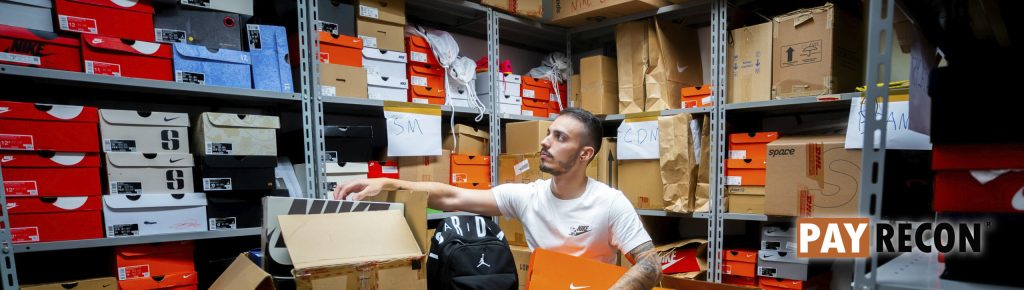
With OMS warehouse management, businesses can manage the entire order fulfillment process from a single system:
Key benefits include:
- Order receiving from multiple channels
- Automated picking lists
- Packing validation
- Shipment confirmation
This improves order accuracy, speeds up fulfillment, and reduces customer complaints caused by wrong or missing items.
Barcode Scanning and Item Tracking

Barcode scanning is a core function of modern OMS warehouse management systems.
It enables:
Accurate inbound and outbound tracking
Faster picking and packing
Reduced human errors
Traceability by batch, serial number, or SKU
Barcode-driven operations are essential for scalable warehouse management and high order volumes.
Automated Warehouse Workflows

OMS warehouse management systems use automated workflows to replace manual processes.
Examples include:
Auto-allocation of stock to orders
Rule-based picking strategies
Automated status updates
System-triggered stock movements
Automation reduces dependency on manual labor while improving consistency and operational efficiency.
Reporting and Analytics

OMS warehouse management systems provide advanced reporting and analytics to support better decision-making.
Common reports include:
Inventory turnover
Order fulfillment speed
Picking accuracy
Warehouse productivity
These insights help businesses identify bottlenecks, reduce costs, and continuously optimize warehouse performance.
What Is an Example of a Warehouse Management System?

A Warehouse Management System (WMS) can exist as:
A standalone WMS
Or a WMS module integrated within an OMS system
Examples of warehouse management systems include:
- OMS systems with built-in WMS modules
- Cloud-based OMS solutions for e-commerce and 3PL
- Multi-warehouse OMS platforms with barcode support
In practice, modern businesses increasingly choose OMS systems with strong warehouse management capabilities, as they eliminate integration complexity and provide end-to-end operational visibility.
OMS Warehouse Management vs Standalone WMS
| Aspect | OMS Warehouse Management | Standalone WMS |
|---|---|---|
| System Integration | Fully integrated with finance, sales, purchasing | Requires third-party integration |
| Data Visibility | Single source of truth | Fragmented data |
| Automation | End-to-end workflows | Limited to warehouse only |
| Scalability | High | Depends on integrations |
For growing businesses, OMS-based warehouse management offers better scalability and control.
Benefits of Warehouse Management in OMS
Implementing warehouse management in OMS helps businesses:
Improve operational efficiency
Reduce inventory and fulfillment errors
Lower labor and operational costs
Scale warehouse operations easily
Increase customer satisfaction
This makes OMS warehouse management a core component of modern supply chain management.
Conclusion
Warehouse management in OMS is no longer optional for businesses aiming to scale efficiently. By combining inventory control, order management, automation, and analytics into a single system, OMS-based warehouse management delivers accuracy, efficiency, and long-term growth.