BIR E-Invoicing Philippines Extend Deadline to December 2026: What Businesses Need to Know
Disclaimer : This article is published for informational purposes only and is intended to provide general guidance based on publicly available information regarding the BIR E-Invoicing Philippines updated e-invoicing deadline. It does not constitute legal, tax, or professional advice. Readers are encouraged to verify details directly with the Bureau of Internal Revenue (BIR) or consult qualified professionals before making any compliance decisions.
Regulatory policies may change without prior notice, particularly when issued through official BIR regulations and circulars. Therefore, businesses must remain vigilant and responsive to updates that may impact compliance timelines.
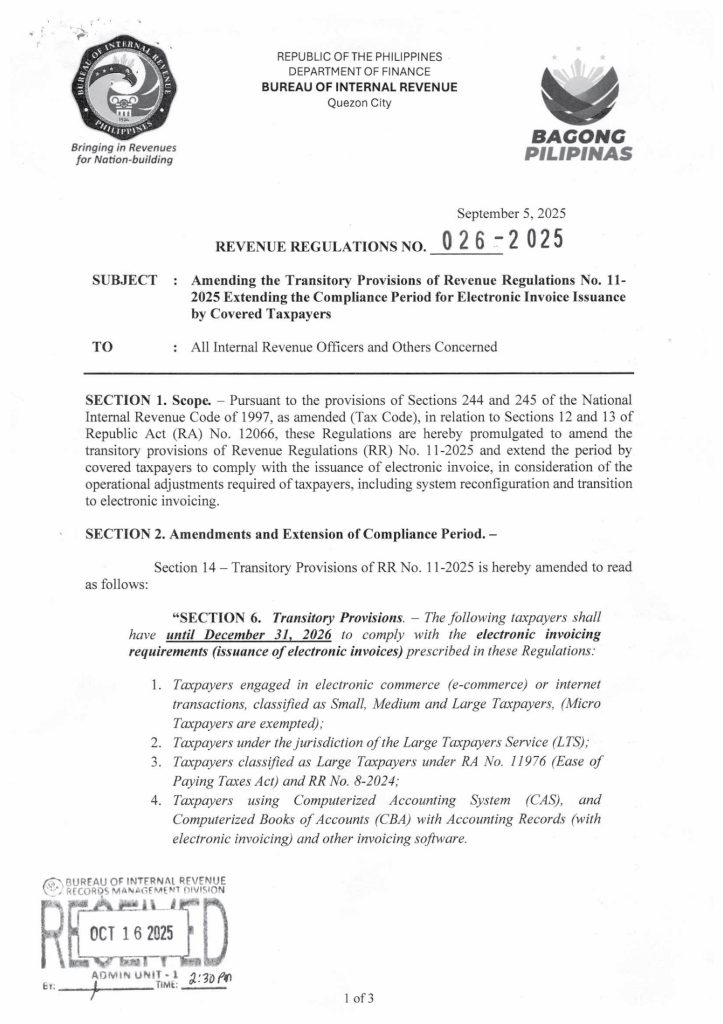
In line with this evolving regulatory landscape, the Bureau of Internal Revenue (BIR) has officially extended the deadline for compliance with its Electronic Invoicing System (EIS) requirements—signaling a degree of flexibility within its broader digital transformation strategy.
Specifically, under Revenue Regulations No. 26-2025, businesses that were originally expected to comply by March 2026 are now granted an extension until December 31, 2026 to fully implement electronic invoicing.
As a result, companies now have additional time to properly align their accounting systems, invoicing processes, and reporting workflows with BIR standards.
More importantly, this extension allows organizations to transition in a structured manner—minimizing operational disruption while ensuring long-term compliance readiness.
Why the BIR E-Invoicing Philippines Deadline Was Extended
According to former BIR Commissioner Romeo Lumagui Jr., the decision to extend the deadline was made to ensure that businesses are adequately prepared before enforcement formally begins.
This is particularly important because transitioning to e-invoicing is not a simple administrative update—it requires structural and operational adjustments across multiple levels of the organization.
In practice, implementation typically involves:
- System upgrades, to support compliant invoice generation and reporting formats
- Budget allocation, covering software, integration, and potential consulting costs
- Staff training, ensuring finance and operations teams understand new workflows
- Data restructuring, especially standardizing tax codes, customer records, and chart of accounts
- Software integration, aligning accounting, ERP, POS, and reporting systems
Given these requirements, digital transformation cannot realistically happen overnight.
Recognizing this operational reality, the BIR has chosen a measured approach—prioritizing guidance and education rather than immediate enforcement penalties. This signals regulatory intent to encourage structured compliance rather than punitive transition.
Nevertheless, the overarching objective remains unchanged: to build a faster, more transparent, and digitally enabled tax administration system that improves reporting accuracy and reduces systemic inefficiencies.
Who Is Covered by the E-Invoicing Mandate?
With the revised implementation timeline now in place, it is equally important to clarify which taxpayers fall within the scope of the mandate.
The extended deadline applies specifically to categories of taxpayers that have been formally identified and required to adopt electronic invoicing under the BIR framework.
In other words, the extension does not automatically cover all businesses. Rather, it is limited to those entities that are explicitly mandated to transition to the Electronic Invoicing System (EIS) based on regulatory classification, revenue thresholds, or industry designation.
Therefore, companies must first determine whether they belong to the covered taxpayer groups before planning their compliance roadmap.
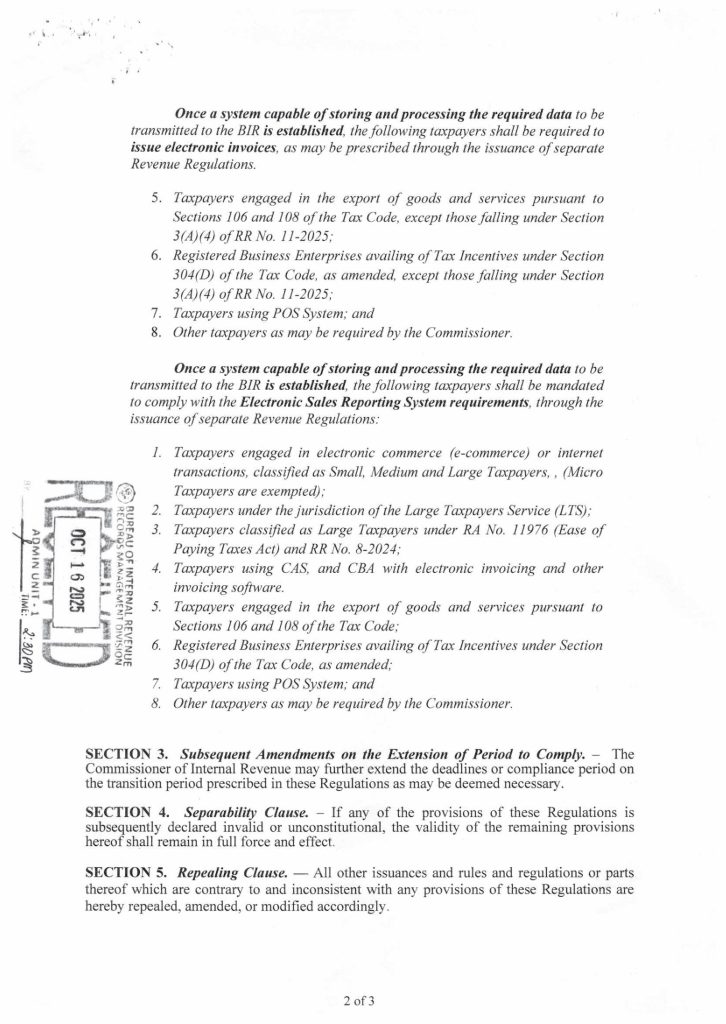
1. E-Commerce and Online Businesses
Businesses engaged in online or internet-based transactions—including Small, Medium, and Large taxpayers—are required to comply. Micro enterprises remain exempt.
2. Large Taxpayers Under LTS
Taxpayers under the Large Taxpayers Service (LTS) must comply, except existing pilot EIS users.
3. Taxpayers Under Specific Laws
Entities covered under Republic Act No. 11976 (Ease of Paying Taxes Act) and RR No. 8-2024 are included.
4. CAS and CBA Users
Businesses using Computerized Accounting Systems (CAS), Computerized Books of Accounts (CBA), and invoicing software fall under the mandate.
5. Exporters
Exporters of goods and services under Sections 106 and 108 of the Tax Code are required to transition, subject to certain regulatory exemptions.
6. Registered Business Enterprises (RBEs)
RBEs enjoying tax incentives under Section 304(D) of the Tax Code must adopt electronic invoicing.
7. POS System Users
Businesses operating Point-of-Sale (POS) systems are also required to comply.
8. Other Taxpayers as Determined by the Commissioner
The Commissioner retains discretion to include additional categories when necessary.
Once a covered business establishes the capability to store and transmit required data to the BIR, it must issue electronic invoices in accordance with separate regulations.
Part of a BIR E-Invoicing Philippines Bigger Digital Strategy
The extension does not signal delay in digital reform.
Instead, it aligns with the BIR’s long-term roadmap toward full digitalization by 2028.
The Electronic Invoicing System (EIS) is designed to operate alongside the upcoming Electronic Sales Reporting System (ESRS), which will further enhance reporting transparency and automation.
Together, these systems aim to modernize tax compliance across the Philippines.
What Businesses Should Do Now
While the deadline has been moved to December 2026, businesses should treat this extension as a preparation window rather than a postponement.
Key steps include:
- Reviewing accounting and invoicing systems
- Assessing integration capabilities
- Allocating transition budgets
- Conducting internal system testing
- Training finance teams
Although the Commissioner may extend the deadline further if necessary, companies are strongly encouraged to prepare early to avoid last-minute compliance risks.
Frequently Asked Questions: BIR E-Invoicing Philippines Extension Explained
1. When is the new deadline for mandatory e-invoicing compliance?
Covered taxpayers are now required to implement electronic invoicing on or before December 31, 2026.
The previous compliance target was March 2026, but this was officially revised through Revenue Regulation (RR) No. 26-2025. The extension grants businesses additional preparation time before full enforcement.
2. Who is required to comply with BIR e-invoicing?
Electronic invoicing is mandatory for specific categories of taxpayers identified by the BIR. These include:
- Large Taxpayers under the Large Taxpayers Service (excluding existing EIS pilot users)
- Businesses engaged in e-commerce or online transactions (except micro enterprises)
- Taxpayers using Computerized Accounting Systems (CAS) or Computerized Books of Accounts (CBA)
- Entities covered under relevant revenue regulations and tax legislation
Businesses falling within these classifications must transition to electronic invoice issuance by the December 2026 deadline.
3. What if a business is not ready by the deadline?
Under the Tax Code, noncompliance with tax regulations may result in penalties.
However, the BIR has indicated that its current approach prioritizes system readiness, guidance, and education rather than immediate punitive enforcement.
The extension reflects the agency’s recognition that digital transformation requires system upgrades, financial planning, and structured implementation. Businesses are therefore encouraged to use the extended timeline proactively rather than waiting for enforcement actions.
4. Why did the BIR decide to extend the deadline?
The BIR acknowledged that implementing electronic invoicing is not merely a procedural adjustment, but a comprehensive operational shift. In practice, businesses are expected to undertake several structural changes, including:
Reconfiguring accounting systems, to ensure compatibility with mandated e-invoicing formats
Ensuring robust data storage and transmission capabilities, particularly for secure and compliant reporting
Allocating budget for necessary software upgrades, integration tools, and possible consultancy support
Training finance and IT personnel, so internal teams can manage the new compliance framework effectively
Given these operational demands, the extension is intended to provide sufficient transition time, allowing businesses to implement the necessary adjustments in a controlled and structured manner.
Importantly, the objective is not delay—but preparedness. The long-term policy direction remains consistent: building a faster, more accurate, and digitally integrated tax reporting ecosystem that enhances transparency and administrative efficiency.
5. What is Revenue Regulation No. 26-2025?
Revenue Regulation No. 26-2025 is the official issuance that formalizes the extension of the electronic invoicing compliance period.
It amends the transitional provisions under Revenue Regulation No. 11-2025 and establishes December 31, 2026 as the updated deadline for covered taxpayers.