SAP WMS vs EWM Explained: Strategic Comparison Guide for Growing Warehouses
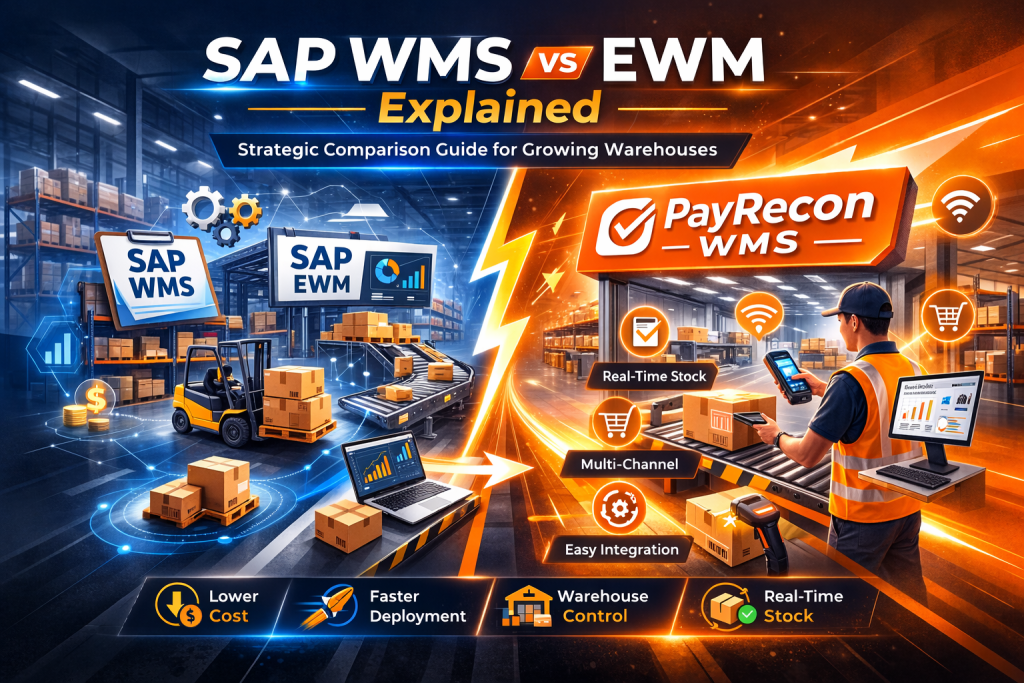
Choosing between SAP WMS and EWM is not just a software comparison. It is a strategic decision about how complex your warehouse operations truly are and how far your business is prepared to evolve.
Introduction
When businesses begin researching SAP warehouse solutions, they are usually experiencing operational pressure. Orders are increasing, SKUs are expanding, and warehouse mistakes are becoming more visible. What begins as an inventory issue gradually turns into a systems architecture discussion.
In Philippines and Southeast Asia, many SMEs start this journey from accounting software with basic stock modules. These systems claim to have inventory features, but they are not true warehouse management systems. They are accounting tools with stock tracking.
Understanding the differences between SAP WM and SAP EWM therefore requires clarity about where your business stands today. It also requires evaluating whether enterprise ERP extensions are necessary, or whether a purpose-built solution like PayRecon WMS is the smarter operational move.
What SAP WMS vs EWM Really Means
The discussion around SAP warehouse platforms is often misunderstood as a simple “basic versus advanced” comparison. In reality, both are enterprise-oriented systems.
SAP WM refers to warehouse functionality embedded inside traditional SAP ERP environments. It supports structured warehouse processes but remains tightly coupled to ERP architecture. Official documentation outlines its ERP-centric design and integration model.
Reference: SAP Official Overview – Extended Warehouse Management
https://www.sap.com/products/scm/extended-warehouse-management.html
SAP EWM, or Extended Warehouse Management, is a more advanced platform designed for high-complexity environments. It supports labor management, yard management, and deeper automation integration. Industry analyses highlight its scalability and broader functional scope compared to legacy WM.
Reference: LeverX – SAP WM vs SAP EWM Differences
https://leverx.com/newsroom/sap-wm-vs-sap-ewm
When companies evaluate SAP WMS vs EWM, they are effectively choosing between two enterprise-grade warehouse architectures within the SAP ecosystem. This decision assumes ERP-level infrastructure readiness.
For many SMEs, that assumption does not align with reality.
The Bigger Problem: You Are Not Using a Real WMS
Before diving deeper into SAP WMS vs EWM, most SMEs should ask a more uncomfortable question.
Are we even using a real warehouse management system?
- Stock in and stock out recording
- Basic quantity adjustments
- Simple reporting
- Financial reconciliation
- Guided picking workflows
- Bin-level optimization
- Intelligent replenishment
- Real-time task management
- Marketplace-driven fulfillment orchestration
These systems are primarily designed for accountants. Warehouse logic is secondary.
When businesses compare sap wms vs ewm from this starting point, they are jumping from very basic inventory tracking to full enterprise warehouse architecture. That is a massive leap.
This is why many growing companies turn to PayRecon WMS instead. PayRecon WMS is not an ERP extension or accounting add-on. It is a purpose-built warehouse management system designed specifically for SME operational realities.
Complexity and Cost: Enterprise Power Comes with Enterprise Burden
The SAP WMS vs EWM decision carries serious implications in terms of cost and complexity.
- Higher implementation costs
- Longer deployment timelines
- Strong IT governance requirements
- Dedicated SAP consultants
- Structured master data discipline
SAP WMS, while less advanced than EWM, still requires ERP integration, SAP expertise, and structured change management.
For multinational enterprises with regional distribution centers, this investment may be justified.
For SMEs operating one or two warehouses in Philippines, the cost-benefit ratio becomes more questionable.
Evaluating SAP WMS vs EWM without considering organizational readiness often leads to over-engineering. The software may be powerful, but daily warehouse teams may struggle with adoption.
- Barcode-driven receiving and picking
- Real-time stock visibility
- Marketplace order integration
- Multi-channel synchronization
- SME-friendly implementation scope
This alignment reduces resistance while delivering immediate operational control.
Real SME Scenario: From Accounting Chaos to Structured Control
Imagine a mid-sized Philippines distributor selling on Shopee, Lazada, and wholesale channels.
- Picking errors increase
- Stock discrepancies become frequent
- Overselling happens
- Marketplace ratings drop
- Staff overtime rises
Management begins searching for SAP WMS vs EWM. The assumption is that SAP solutions represent the “serious” option.
However, the company is not even running SAP ERP. Migrating into that ecosystem just to fix picking errors may be disproportionate.
The real need is operational execution control.
This is where PayRecon WMS becomes strategically logical. It integrates with accounting systems while operating independently as a warehouse execution layer. Accounting remains accurate. Warehouse operations become structured.
Instead of jumping from basic inventory tracking to enterprise ERP transformation, the company upgrades warehouse maturity step by step.
Architecture Philosophy: ERP-Centric vs Purpose-Built
The SAP WMS vs EWM debate revolves around architecture philosophy.
SAP WMS is embedded within ERP systems. EWM, though more advanced, still operates within SAP’s enterprise framework. This creates strong integration but also high dependency.
- Warehouse logic is independent
- Accounting integration happens via connectors
- Deployment is modular
- Change management is more controlled
For SMEs in Southeast Asia, this separation can be strategically safer. It allows warehouse operations to mature without forcing a full ERP overhaul.
When evaluating SAP WMS vs EWM, the key question is not which has more features. The real question is whether your business needs enterprise ERP architecture right now.
Digital Commerce Pressure Changes the Equation
Ecommerce growth in Philippines has compressed fulfillment timelines. Same-day shipping expectations and real-time stock visibility are now standard.
Accounting software cannot handle this. It reconciles transactions after they happen. It does not manage warehouse execution in real time.
Even when comparing sap wms vs ewm, the focus often remains on enterprise integration rather than daily execution speed.
- Marketplace orders flow into warehouse tasks
- Picking instructions are guided
- Inventory updates instantly
- Overselling risk reduces
- Fulfillment accuracy improves
For many SMEs, the pain point is not enterprise consolidation. It is fulfillment performance.
Strategic Positioning: Avoid Prestige-Driven Decisions
There is brand prestige attached to SAP solutions. However, prestige should not drive architecture decisions.
- Large-scale manufacturers
- Multi-country distribution networks
- High automation environments
- Deep ERP integration strategies
- Single-country SME distributors
- Marketplace-driven sellers
- Businesses upgrading from accounting inventory
- Companies prioritizing fast ROI
PayRecon WMS fills the gap between basic stock tracking and enterprise SAP architecture. It delivers structured warehouse governance without enterprise-level overhead.
Conclusion
The debate between SAP warehouse platforms is ultimately about scale, capital allocation, and operational maturity.
Many SMEs believe they require enterprise-grade systems. In reality, they are still operating on accounting-based inventory modules that lack true warehouse execution control.
Jumping directly into complex ERP-driven environments can introduce unnecessary cost and operational strain.
A more measured path often involves first adopting a purpose-built warehouse system like PayRecon WMS. This strengthens execution, improves accuracy, and prepares the organization for scalable growth.
Strategic transformation should follow operational readiness rather than brand prestige. Grounding system evaluation in realistic business context ensures long-term, sustainable value.