FIFO, FEFO, and FMFO:
Choosing the Best Inventory Approach
In warehouse operations, FIFO, FEFO, and FMFO are the three most commonly used inventory strategies. Each method serves a different operational purpose, depending on product type, shelf life, and quality requirements.
Therefore, selecting the right strategy is not just a technical decision, but a critical factor in maintaining inventory accuracy, product integrity, and operational efficiency.
It has a direct impact on cash flow, product quality, expiry risk, and overall warehouse efficiency.
Choosing the wrong inventory strategy creates:
- Dead stock
- Expiry losses
- Inconsistent picking
FIFO FEFO FMFO define how inventory moves through a warehouse, and each solves a different operational problem. Understanding how these strategies work, and when to use them, is essential for building a warehouse operation that scales.
What is FIFO FEFO FMFO?
FIFO: First In, First Out
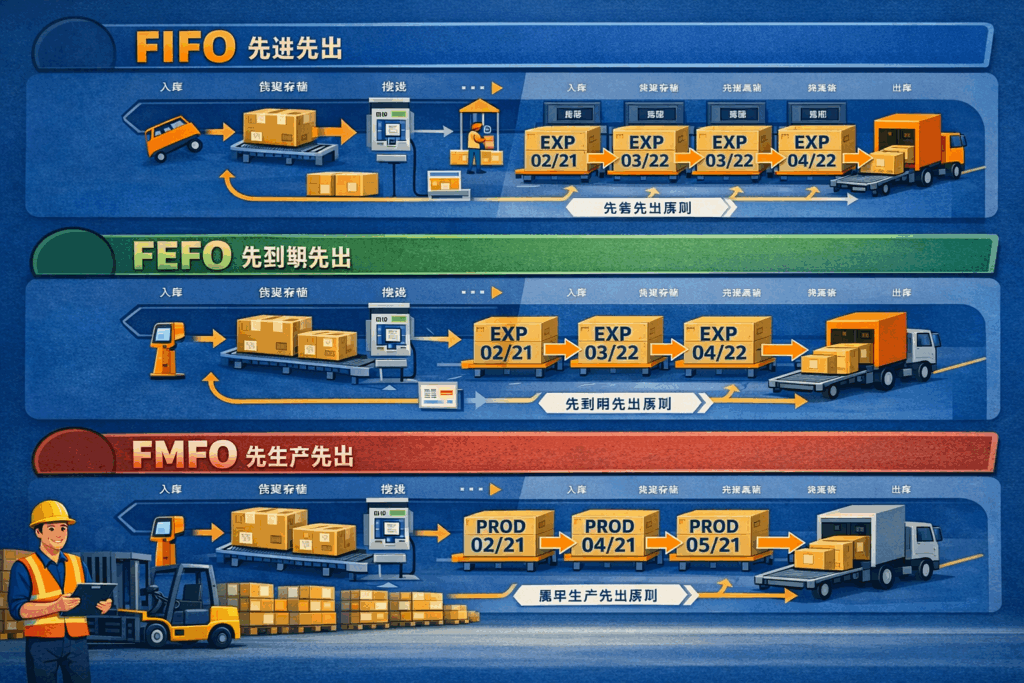
FIFO means items received earlier are shipped earlier. In general, it is commonly used for goods without strict expiry control. When implemented correctly, FIFO helps reduce the risk of old stock sitting too long and eventually becoming unsellable.
However, the real challenge lies in execution. In manual warehouses, newer stock is often placed in front for convenience, which unintentionally blocks older stock behind it. As time passes, FIFO slowly becomes a guideline rather than a strictly enforced process.
In reality, FIFO only works when the system controls the picking sequence. Otherwise, when staff rely on memory or visual judgement, consistency breaks down and the process becomes vulnerable to human error.
FEFO: First Expired, First Out
FEFO moves inventory based on expiry dates, not arrival dates. Therefore, this method is especially important for food, medicine, supplements, and cosmetics, where shelf life directly impacts safety and compliance.
In practice, some products may arrive later but expire sooner. However, without FEFO in place, warehouses often pick the wrong batch, causing items to expire while still in storage. As a result, these losses are usually recorded as stock differences. In reality, they are process problems rather than inventory issues.
To implement FEFO properly, accurate batch and expiry tracking is required. Yet, managing this manually at a larger scale becomes increasingly difficult, error-prone, and operationally inefficient.
FMFO: First Manufactured, First Out
FMFO ships products based on their manufacturing or production date. Unlike FIFO or FEFO, this method prioritises production sequence rather than arrival or expiry timing. Therefore, it is mainly used in manufacturing warehouses where product quality may gradually change over time.
By sending out earlier-produced items first, FMFO helps maintain more consistent product quality in the market. At the same time, it improves traceability across production cycles. In practice, FMFO is often integrated with batch records, quality inspections, and detailed production data. As a result, manufacturers are able to maintain stable, reliable output while strengthening recall readiness and compliance control.
FIFO vs FEFO vs FMFO: Quick Comparison
| Strategy | Priority Basis | Best For | Main Risk If Not Enforced |
|---|---|---|---|
|
FIFO |
Receiving date |
General goods |
Dead stock |
|
FEFO |
Expiry date |
Perishable items |
Expiry losses |
|
FMFO |
Production date |
Manufacturing |
Quality inconsistency |
FIFO FEFO FMFO, Choosing the Right Strategy in Operations
In real warehouse operations, relying on a single inventory strategy is rarely enough. As product lines expand and demand fluctuates, multiple rules often need to coexist. As a result, when these decisions are handled manually, mistakes can easily occur.
To address this challenge, WMS removes the guesswork by assigning strategies by SKU or category and automatically enforcing the correct picking logic. In turn, this ensures consistent execution across all shifts. Consequently, businesses can improve inventory turnover, reduce waste, and ultimately support healthier cash flow.

Making Inventory Strategy Work
Most inventory problems are usually caused by strategies that are not consistently enforced in daily operations. In many cases, a warehouse may have well-defined rules on paper. However, without proper execution, stock can sit idle, perish, or eventually create quality-related issues.
In other words, the gap is not in strategy design, but in operational discipline.
Understanding FIFO, FEFO, and FMFO is only the first step. More importantly, these strategies must be applied consistently across every shift and every order. By using a WMS to automate and enforce these rules, businesses can ensure the right inventory moves at the right time. As a result, waste is reduced, product quality is maintained, and overall inventory turnover and cash flow are significantly improved.
Ready to put your inventory strategy into action? Contact us to see How a WMS can enforce the right inventory strategy for your business.