Oracle WMS Cloud Explained Simply: Capabilities, Costs, and SME Alternatives in Southeast Asia
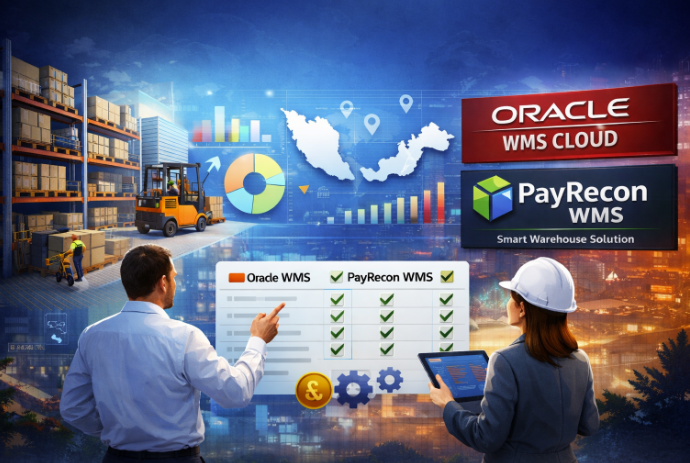
Oracle WMS cloud is often evaluated by growing warehouses seeking operational control beyond basic accounting inventory modules. This analysis explores its capabilities, structural implications, and why SMEs frequently compare it with purpose-built systems such as PayRecon WMS.
Introduction
Warehouse digitalization conversations in Philippines and Southeast Asia are evolving. Businesses are no longer debating whether to adopt systems. They are questioning system architecture, scalability, and operational fit. Many companies begin with accounting software that includes stock tracking. Over time, these tools reveal structural limitations.
Search interest in Oracle WMS cloud typically signals a maturity shift. Decision makers recognize that warehouse execution cannot rely on accounting-led inventory modules. However, enterprise-grade systems introduce cost, ecosystem commitment, and organizational complexity.
This article provides a strategic evaluation rather than a technical walkthrough. It examines where Oracle WMS cloud fits, where it may exceed SME requirements, and why businesses often compare it with modern warehouse-focused platforms like PayRecon WMS.
What Oracle WMS Cloud Actually Represents

Oracle Corporation positions Oracle WMS cloud within its broader Supply Chain Management suite. It is not an accounting extension. It is a cloud-native warehouse execution platform designed for large distribution networks.
According to Oracle’s official product documentation, the platform supports advanced features including:
- Directed putaway
- Wave planning
- Slotting optimization
- Task interleaving
- Yard and labor management
Reference: Oracle Warehouse Management product overview
https://www.oracle.com/scm/logistics/warehouse-management/
From a theoretical standpoint, it aligns with principles described in supply chain research, particularly lean warehousing and flow optimization. For example, Christopher’s framework on supply chain competitiveness emphasizes responsiveness and cost efficiency as strategic differentiators (Christopher, Logistics & Supply Chain Management). 【Academic reference】
The system is engineered for complexity. The strategic question is whether SME warehouse environments require that level of structural depth.
Accounting Inventory vs. Real WMS: Structural Differences
Many businesses assume their accounting software already provides warehouse management. In practice, most accounting systems provide inventory accounting, not operational execution.
The distinction becomes clearer in structured comparison:
| Dimension | Accounting Software Inventory | Oracle WMS Cloud | PayRecon WMS |
|---|---|---|---|
|
Primary User |
Accountant |
Warehouse + IT teams |
Warehouse operators |
|
Core Objective |
Financial reconciliation |
Enterprise warehouse optimization |
SME warehouse execution |
|
Barcode Workflows |
Limited |
Advanced |
Advanced & simplified |
|
Integration Model |
Finance-centric |
ERP ecosystem |
Modular, accounting-integrated |
|
Implementation Complexity |
Low |
High |
Moderate |
This table illustrates a structural reality. Accounting systems focus on ledger integrity. Oracle WMS cloud focuses on enterprise optimization. PayRecon WMS focuses on practical execution for SMEs.
When Philippines distributors run Shopee or Lazada campaigns, warehouse bottlenecks rarely stem from accounting errors. They stem from picking inaccuracy, mislocated stock, and lack of scanning discipline.
Those are operational problems, not financial ones.
Where Oracle WMS Cloud Demonstrates Strength
Oracle WMS cloud excels in environments characterized by:




The platform’s architecture supports dynamic slotting, rule-based picking logic, and workforce productivity measurement. These functions align with advanced warehouse optimization models discussed in academic logistics literature.
For example, slotting optimization relates to velocity-based storage assignment, which improves picking efficiency. Research overview:
https://www.sciencedirect.com/topics/engineering/warehouse-slotting
For multinational enterprises, this sophistication produces measurable ROI. For SMEs with two warehouses and moderate SKU counts, the incremental benefit may diminish relative to cost and administrative overhead.
Cost Structure and Implementation Commitment
Enterprise systems introduce layered cost structures. Oracle WMS cloud typically involves:




Total cost of ownership extends beyond monthly fees. It includes training time, IT resources, and change management.
In contrast, many SMEs evaluating Oracle WMS cloud are transitioning from accounting software like SQL-based systems or local finance platforms. Their operational challenge is scanning adoption and real-time synchronization, not global network optimization.
PayRecon WMS addresses this transitional stage. It integrates into accounting systems rather than replacing them. This preserves financial continuity while upgrading warehouse execution.
From a strategic finance perspective, this reduces switching risk and capital exposure.
Ecosystem Lock-In and Architectural Strategy
Oracle WMS cloud integrates seamlessly within Oracle’s broader ERP ecosystem. For companies already using Oracle ERP, this creates structural efficiency.
However, integration depth can create ecosystem lock-in. Strategic technology literature frequently highlights platform dependency as a risk factor in digital transformation.
Reference on digital platform lock-in dynamics:
https://hbr.org/2019/01/the-high-cost-of-platform-dependency
SMEs in Southeast Asia often operate mixed technology stacks:
In such modular environments, PayRecon WMS provides architectural independence. It enhances warehouse operations without forcing ERP migration.
This modularity reduces strategic risk during scaling phases.
Real SME Scenario: Transition Pathway
Consider a mid-sized Philippines distributor selling through Shopee and B2B channels.
Phase 1:
They use accounting software with inventory modules. Stock discrepancies emerge during peak campaigns.
Phase 2:
They search for enterprise systems and encounter Oracle WMS cloud. The feature set appears comprehensive.
Phase 3:
After cost evaluation, they recognize that their primary requirement is accurate scanning, batch tracking, and real-time integration with accounting.
Phase 4:
They adopt PayRecon WMS to resolve operational execution gaps without overhauling financial infrastructure.
This trajectory is common. The decision is not about prestige. It is about proportional fit.
Capability Overview at Strategic Level
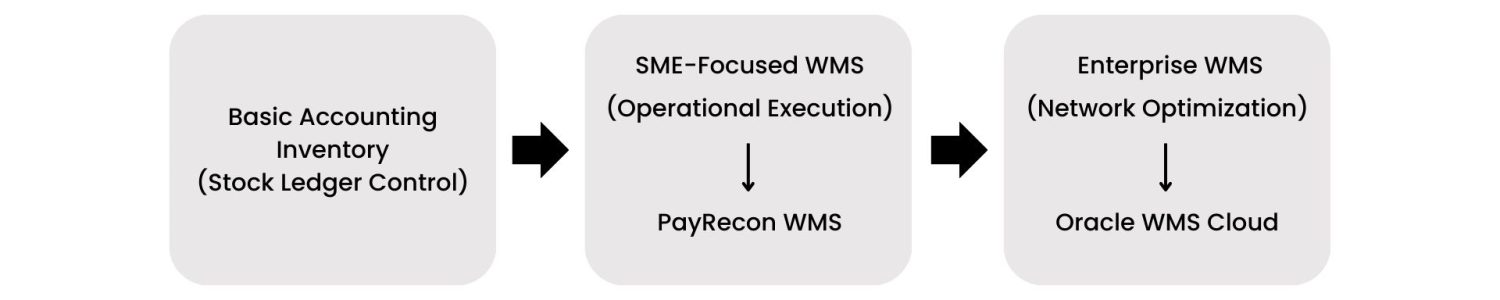
Below is a simplified capability positioning framework:
This visualization clarifies evolutionary positioning. Accounting systems manage stock records. PayRecon WMS manages warehouse execution. Oracle WMS cloud manages enterprise distribution complexity.
Each tier serves a different operational maturity level.
When Oracle WMS Cloud Makes Strategic Sense
The organization operates across multiple countries.
ERP standardization is a corporate mandate.
IT governance supports enterprise configuration cycles.
Capital investment prioritizes long-term global integration.
In such environments, enterprise depth justifies structural weight.
Faster implementation
Marketplace integration
Reduced administrative overhead
Predictable cost structure
For these businesses, purpose-built systems such as PayRecon WMS often provide stronger ROI during growth phases.
Conclusion
Oracle WMS cloud represents enterprise-grade warehouse management embedded within Oracle’s supply chain ecosystem. It offers advanced configuration, optimization, and integration depth suited for multinational operations.
However, many SMEs exploring Oracle WMS cloud originate from accounting software environments with basic inventory modules. Their operational challenge is not global network optimization. It is warehouse execution discipline.
PayRecon WMS addresses this execution gap directly. It is purpose-built for warehouse operations, not accounting reconciliation. It integrates with financial systems rather than replacing them.
The strategic decision should not focus solely on feature breadth. It should evaluate proportional complexity, cost exposure, ecosystem dependency, and operational maturity.
Enterprise solutions reward structural scale. Modular WMS platforms reward execution agility. Sustainable growth depends on choosing architecture aligned with realistic operational trajectory, not aspirational branding.